
African Safari Vacations — Planned Free
Stacey Vacations plans African safaris at no fee — Kenya, Tanzania, South Africa, Botswana, and gorilla trekking in Rwanda and Uganda. I'm Stacey Haines, a Florida-based travel agent with Castle Dreams Travel, and the suppliers pay my commission, so expert planning costs you nothing.
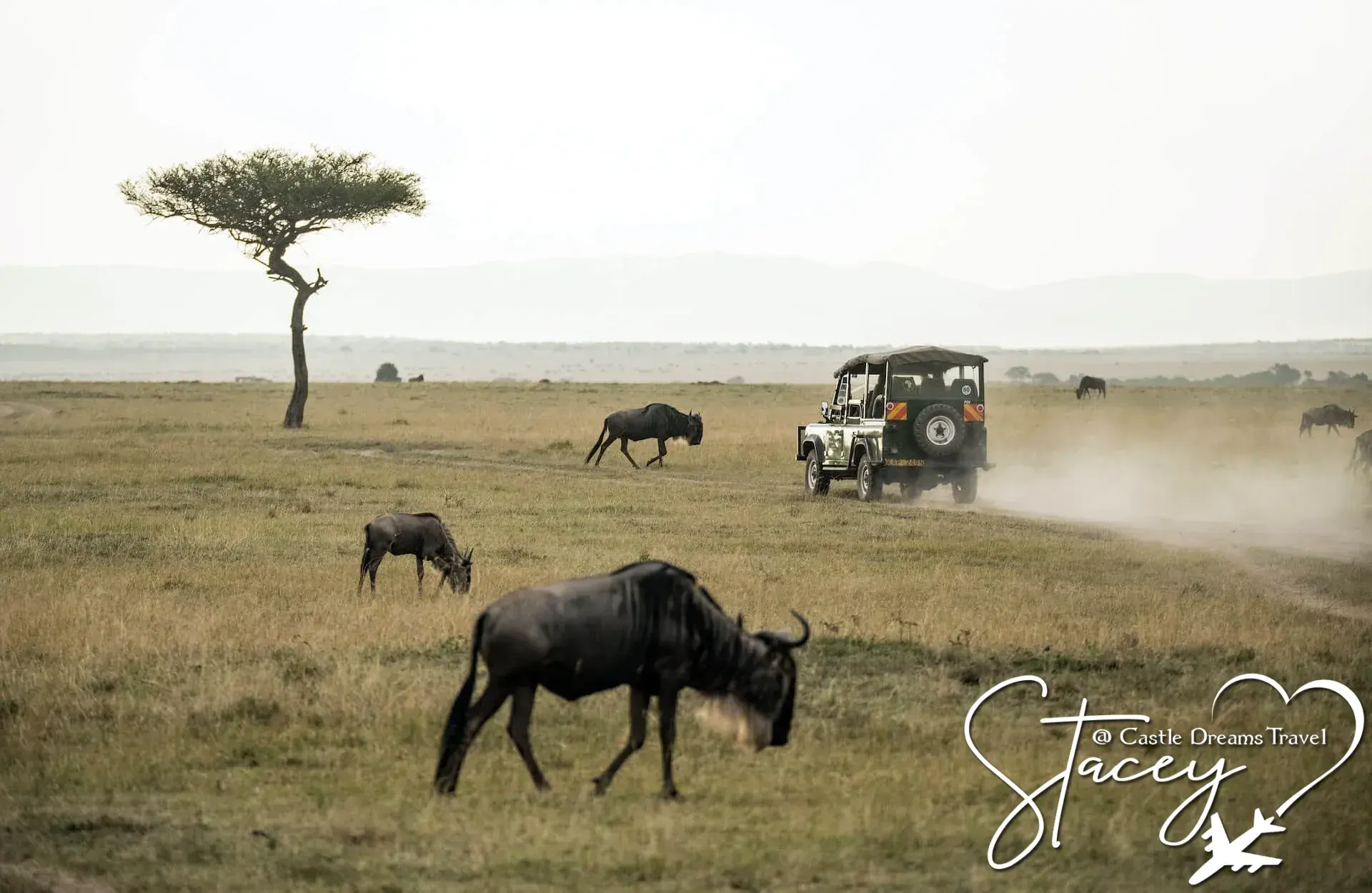
A safari is the rare trip that exceeds the daydream: the Big Five — lion, elephant, rhino, leopard, buffalo — moving through the Serengeti or the Maasai Mara, where the wildebeest migration churns across the plains each year.
It is also the trip where the details decide everything. Two people can book the same week in the same country and have completely different holidays depending on which month they chose and whether their camp sits inside a national reserve or a private conservancy. Timing is everything on safari — the migration, the dry seasons, the gorilla permits — so this is the one trip I'd never book blind.
When to Go on Safari
For general game viewing, the dry season is the answer: roughly June through October. Vegetation thins out and water sources shrink, so animals gather at rivers and waterholes and become far easier to find. It is also the busiest and most expensive stretch of the year, which is the trade-off.
The Great Migration river crossings run roughly July through October, with August and September the classic window. Calving season is different and quietly wonderful — January and February in the southern Serengeti, when hundreds of thousands of wildebeest give birth within a few weeks and the predators arrive for it.
Green season has real advantages too: fewer vehicles, lower rates, dramatic skies for photography, and resident wildlife that does not go anywhere just because the herds have moved on.
The Great Migration
The migration is not an event with a date. It is a continuous loop of well over a million wildebeest, plus zebra and gazelle, following the rain around the Serengeti–Mara ecosystem all year.
The part everyone pictures — the river crossings, where the herds mass on a bank and then pour into crocodile water — happens where the Mara and Talek rivers cut the northern Serengeti and the Maasai Mara. Those primary crossing points sit inside the reserve boundaries, which matters when you choose where to sleep.
Nothing about it is guaranteed on a given morning. What good planning buys you is being in the right place during the right weeks, with enough nights to give the herds a chance to perform.
Private Conservancy or National Reserve?
This is the single most consequential choice on a safari, and most first-time travellers have never heard of it.
In a national reserve, game drives must stay on designated tracks, and night drives are not permitted. In the private conservancies that border the reserves, off-road game viewing, walking safaris and night drives are all allowed, vehicle numbers are limited, and the fees flow directly to the Maasai communities who own the land.
So the reserve is where the river crossings are, and the conservancy is where the quiet, flexible, get-closer safari happens. Plenty of my clients do not choose — they split the trip and take a few nights of each, which is usually the right answer during migration season.
Choosing Your Country
Kenya is the most straightforward introduction: the Maasai Mara is quick and comparatively easy to reach from Nairobi, and it is prime migration territory from roughly July to October.
Tanzania gives you the Serengeti's enormous scale plus the Ngorongoro Crater, and the southern plains for calving season. Moving between areas is normally done by light aircraft rather than road — driving the Serengeti–Mara border adds a full day and a border crossing.
South Africa suits first-time and family safaris well: Kruger and the private reserves alongside it are easy to combine with Cape Town and the winelands, which makes a safari feel less like an expedition and more like a two-part holiday.
Botswana is the water safari — the Okavango Delta, seen from a mokoro as much as from a vehicle, under a deliberately low-volume, high-value tourism model.
Gorilla Trekking
Tracking mountain gorillas in Rwanda or Uganda is a separate kind of trip and, for many people, the most affecting hour of their lives.
Permits are strictly limited in number and sell months ahead, and the permit — not the flight, not the lodge — is what dictates your dates. If gorillas are on your list, that is the first thing we lock and everything else is built around it.
What a Safari Day Actually Looks Like
You are up before dawn, because that is when predators are still moving. A long morning game drive, back to camp as the heat builds, then a genuinely unhurried middle of the day — brunch, a nap, the pool if there is one.
Out again around four, when the light turns and the animals do too, staying out to sunset and a sundowner somewhere with a view. If you are in a conservancy, the drive can continue into the dark, which is when a completely different set of animals appears.
It is a slower, earlier rhythm than most holidays, and almost everyone falls into it by day two.
Planning Your Safari Costs You Nothing
I do not charge planning or service fees. The lodges, camps and operators pay the commission, so you get the research, the timing advice, the reserve-versus-conservancy conversation and someone watching your booking, at no cost to you.
Multigenerational families, friends' getaways, and corporate retreats — one planner coordinates every traveler, with zero fees.
Quick answers
Customized vacation packages, cruises and resorts — planned for you, never a planning fee.
Get a Free Quote